At the end of the movie MEN IN BLACK 3 there's a great line from Tommy Lee Jones, "How do I know what I don't know?" It's a situation we often find ourselves in. We don't know what we don't know even though our life may depend on it. So where do we go to learn what we don't know?
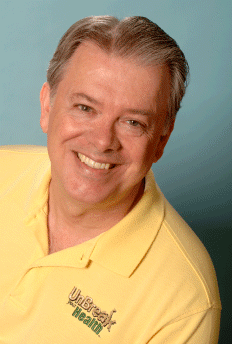
How about a comprehensive introductory guide to the field of health? That's why I wrote HOW TO UNBREAK YOUR HEALTH years ago after my own challenges with health. When even the Mayo Clinic couldn't help me I went in search of other answers in the field of complementary and alternative medicine. Fortunately I found PSYCH-K and it helped resolve my health problems. I thought there might be others in the same situation of not knowing what they don't know so I wrote the book as a simple, easy-to-read introduction to the field with over 300 listings.
I was reminded of this bit of history recently when I went back to PSYCH-K to deal with new health challenges (the fun of getting older). Once again the technique opened new doors and helped me find the answers to my health issues.
When faced with a health challenge don't despair. Instead look for your own answers. Don't rely on doctors and medical tests to make your decisions for you. YOU know your body and mind better than anyone so take control of your own life!
Start by reading HOW TO UNBREAK YOUR HEALTH and you'll be on your way to a brighter, healthier you.
Friday, June 12, 2020

Tuesday, March 31, 2020
Pandemic Depression
During this time of historic change in society many people are feeling depressed. I'd like to remind them of the best non-prescription solution to depression, a book by Dr. David D. Burns titled FEELING GOOD - The New Mood Therapy. The techniques he describes have been proven effective in treating depression so read it and change your life.
Monday, February 17, 2020
Heal Movie
I just watched a fascinating movie called "HEAL" which featured a wide collection of experts on the topic of healing. Naturally Dr. Bruce Lipton was one of the interviews as he explained how our cells react to our environment, including our mental landscape.
The movie reminded me of a video I did many years ago called "A CHORUS FOR QUALITY" to promote a concept called Total Quality Management or TQM. I flew around the country and interviewed all sorts of folks and put them all into one movie explaining how we can all do something to improve the quality of our products and services.
One of the most interesting interviews in the movie "HEAL" was a researcher looking into miraculous healings from cancer. She said that one of the common elements in all of these people was a complete belief that they would heal, so they did. Not a wish or a hope, but a certainty. In other words, they changed their mental and emotional landscape.
I recommend this movie if you have any interest in more natural healing.
The movie reminded me of a video I did many years ago called "A CHORUS FOR QUALITY" to promote a concept called Total Quality Management or TQM. I flew around the country and interviewed all sorts of folks and put them all into one movie explaining how we can all do something to improve the quality of our products and services.
One of the most interesting interviews in the movie "HEAL" was a researcher looking into miraculous healings from cancer. She said that one of the common elements in all of these people was a complete belief that they would heal, so they did. Not a wish or a hope, but a certainty. In other words, they changed their mental and emotional landscape.
I recommend this movie if you have any interest in more natural healing.
Friday, January 10, 2020
Dr. Dean Ornish Likes My Book
If you have heart disease or diabetes or many other health problems you've probably already heard of Dr. Dean Ornish. He has revolutionized health care by reversing heart disease and other problems without surgery or drugs but by lifestyle changes. I wrote about Dr. Ornish in my book, How To UnBreak Your Health, several years ago. I even tried to interview him for my podcast show but I couldn't get through to him and his staff always said he was too busy (at least for a podcast).
I think Dr. Ornish likes my book because he just published a new book called UnDo It! How Simple Lifestyle Changes Can Reverse Most Chronic Diseases. Is it just my imagination or did he use the "undo" idea in his title because of my book? In any case you can learn more by clicking on Dr. Ornish.
It's a new year, time to get healthy and stay healthy!
I think Dr. Ornish likes my book because he just published a new book called UnDo It! How Simple Lifestyle Changes Can Reverse Most Chronic Diseases. Is it just my imagination or did he use the "undo" idea in his title because of my book? In any case you can learn more by clicking on Dr. Ornish.
It's a new year, time to get healthy and stay healthy!
Tuesday, November 26, 2019
America Has a Health Problem
The conclusions from a
comprehensive new study by researchers at Virginia Commonwealth
University showing that mortality rates for U.S. adults ages 25-64
continue to increase, driving down the general population’s life
expectancy for at least three consecutive years should not be ignored.
The report, “Life Expectancy and Mortality Rates in the United States, 1959-2017,’’
was published Tuesday in the Journal of the American Medical
Association. The study paints a bleak picture of a workforce plagued by
drug overdoses, suicides and organ-system diseases while grappling with
economic stresses.
In a trend that cuts across racial and ethnic
boundaries, the U.S. has the worst midlife mortality rate among 17
high-income countries despite leading the world in per-capita spending
on health care.
And while life expectancy in
those other industrialized nations continues to inch up, it has been
going in the opposite direction in America, decreasing from a peak of
78.9 years in 2014 to 78.6 in 2017.
By comparison, according to the Peterson-Kaiser Health System Tracker,
the average longevity in similar countries is 82.2 years. Japan’s is
84.1, France’s 82.4 and Canada’s 81.9. They left the U.S. behind in the
1980s and increased the distance as the rate of progress in this country
diminished and eventually halted in 2011.
Steven
Woolf, director emeritus of the VCU Center on Society and Health and
the study’s lead author, said the reasons for the decline go well beyond
the lack of universal health care in the U.S. – in contrast with those
other nations – although that’s a factor. “It would be easier if we could blame this whole trend on one problem,
like guns or obesity or the opioid epidemic, all of which distinguish
the U.S. from the other countries,’’ Woolf told USA TODAY. “But we found
increases in death rates across 35 causes of death.’’
I think the bigger question is what is it going to take for America for finally start paying attention to what's happening ... and begin to do something about it?
Monday, November 18, 2019
Told You So
On the front page of the Dallas Morning News (and many other newspapers) on November 17, 2019 was the headline: "Study: Surgery not best for all" and the lengthy article explained the massive study named ISCHEMIA. While invasive procedures like insertion of a stent or even by-pass surgery better than pills at reducing patients' chest pain during exercise the study found no difference in a wide variety of heart-disease outcomes including heart attacks and even cardiac death.
Is anyone surprised that a legion of cardiac specialists are against this study? After all, there are 500,000 heart stent procedures every year in the U.S. which is millions of dollars for doctors, hospitals, even stent manufacturers. But now we have a huge federal study that says there's no reason to rush into these invasive procedures for patients with stable heart disease.
Have you ever heard of the Ornish Program? Dr. Dean Ornish developed it many years ago and it is the most effective program to reverse heart disease available ... and it's all natural. Based on a plant-based diet the program includes medication and other tools for the body to heal itself. It has been proved so successful that Medicare even pays for it!
Surgery and even drugs may make money for a lot of folks but it isn't necessarily the best treatment.
Is anyone surprised that a legion of cardiac specialists are against this study? After all, there are 500,000 heart stent procedures every year in the U.S. which is millions of dollars for doctors, hospitals, even stent manufacturers. But now we have a huge federal study that says there's no reason to rush into these invasive procedures for patients with stable heart disease.
Have you ever heard of the Ornish Program? Dr. Dean Ornish developed it many years ago and it is the most effective program to reverse heart disease available ... and it's all natural. Based on a plant-based diet the program includes medication and other tools for the body to heal itself. It has been proved so successful that Medicare even pays for it!
Surgery and even drugs may make money for a lot of folks but it isn't necessarily the best treatment.
Sunday, October 6, 2019
The First Cells
I rarely write about positive events in mainstream medicine but the Wall Street Journal's Review section recently featured a great front-page essay from a new book titled The First Cell and the Human Costs of Pursuing Cancer to the Last. You may have been impressed with all of the decreases in cancer rates since 1990 but the reality is that we've simply returned them to where they were in the 1930's, before the growth of cigarettes (and I would add processed foods). Today the newest methods to treat cancer that are generating the most research and expense tend to be focused on treating the worst cases - chasing after the last cancer cells in end-stage patients.
The book, to be published October 15th, calls for a paradigm shift. We need to focus instead on the first cancer cells to prevent the growth of the disease in healthy patients. (What a concept!) This prevention would be the cheapest, fastest and safest alternative to the current treatment protocols of "slash, poison and burn." Cancer is much too complex to be solved with simple reductionism that tries to match each cancer with the proper drug which is why 95% of new cancer drugs fail to receive FDA approval and the other 5% barely deserve it.
The last paragraph of the essay sums it up: "What's missing from today's discussion of cancer is the admission that current strategies have failed and we need to take a 180-degree turn. We now invest a lot of effort into finding minimal residual disease. Why not apply the same rigor and focus to finding minimal initial disease? Cancer research has been promising hope and delivering disappointments for a half-century. Instead of letting cancer grow into its end-stage monstrosity, let us assemble our resources to pre-empt that battle and strike instead at cancer's root: the first cells."
Maybe there is hope in mainstream medicine if more doctors accept the reality ot medicine today. After all, this proposed attitude shift sounds a lot like what's been done by complementary and alternative medicine for hundreds, even thousands, of years.
The book, to be published October 15th, calls for a paradigm shift. We need to focus instead on the first cancer cells to prevent the growth of the disease in healthy patients. (What a concept!) This prevention would be the cheapest, fastest and safest alternative to the current treatment protocols of "slash, poison and burn." Cancer is much too complex to be solved with simple reductionism that tries to match each cancer with the proper drug which is why 95% of new cancer drugs fail to receive FDA approval and the other 5% barely deserve it.
The last paragraph of the essay sums it up: "What's missing from today's discussion of cancer is the admission that current strategies have failed and we need to take a 180-degree turn. We now invest a lot of effort into finding minimal residual disease. Why not apply the same rigor and focus to finding minimal initial disease? Cancer research has been promising hope and delivering disappointments for a half-century. Instead of letting cancer grow into its end-stage monstrosity, let us assemble our resources to pre-empt that battle and strike instead at cancer's root: the first cells."
Maybe there is hope in mainstream medicine if more doctors accept the reality ot medicine today. After all, this proposed attitude shift sounds a lot like what's been done by complementary and alternative medicine for hundreds, even thousands, of years.
Subscribe to:
Posts (Atom)


 Posts
Posts