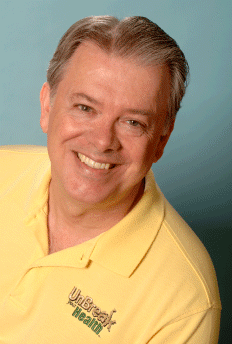
My latest interview was on the Fun & Fit show on WomensRadio which started airing today. It really was a lot of fun to talk with identical twins Kymberly and Alexandra, they really do enjoy being radio stars!
When you check out their website be sure to click on their Facebook fan page to enter the contest to win a free autographed copy of my book.
Showing posts with label complementary and alternative medicine. Show all posts
Showing posts with label complementary and alternative medicine. Show all posts
Wednesday, September 14, 2011

Monday, November 29, 2010
Philippine Traditional and Alternative Health Care Month
Did you know that by Presidential Proclamation #698 in 1997 the Philippines celebrate the month of November as Traditional and Alternative Health Care Month? They've already figured out prevention is more affordable than treatment so primary health care is a priority. They've also discovered that healthy lifestyles promoted in many types of complementary and alternative medicine prevent many health problems. It (CAM) can also offer effective and affordable treatments for a variety of health problems.
It reminds me of the vote in Switzerland this year that placed many forms of CAM into the nation's constitution to protect every citizen's right to them. For those of you thinking that only the primitive or unintelligent would be involved with complementary and alternative medicine I hope you don't consider the Swiss to have either of those qualities!
The rest of the world never forgot their native health systems but simply added Western medicine to their list of options. Only America has tried to make CAM illegal in order to support the profits of drug manufacturers and the medical industry. Today the tide is turning as more and more Americans turn to more natural forms of healing.
It reminds me of the vote in Switzerland this year that placed many forms of CAM into the nation's constitution to protect every citizen's right to them. For those of you thinking that only the primitive or unintelligent would be involved with complementary and alternative medicine I hope you don't consider the Swiss to have either of those qualities!
The rest of the world never forgot their native health systems but simply added Western medicine to their list of options. Only America has tried to make CAM illegal in order to support the profits of drug manufacturers and the medical industry. Today the tide is turning as more and more Americans turn to more natural forms of healing.
Tuesday, November 23, 2010
Newest CAM is Most Researched
One of the newest forms of complementary and alternative therapies is also one of the most researched. IBMT or Integrative Body-Mind Training was developed from Traditional Chinese Medicine by Dr. Yu-Yuan Tang in 1990 in China. Since then he's published more than 170 nationally and internationally peer-reviewed articles about this amazing innovation. Currently he's a visiting professor at the University of Oregon.
IBMT is the latest podcast to be added to the growing library of programs about complementary and alternative therapies at UnBreak Your Health. The interview with Dr. Tang was very informative about this amazing and very fast form of meditation or mindfulness. "The path is the goal" with IBMT.
This is also an exception in the second edition of How To UnBreak Your Health because the therapy isn't even available in the United States yet. Because of the source of IBMT and its fast-growing scientific reputation I felt it needed to be included in the book. IBMT may be very popular before the next edition comes out.
IBMT is the latest podcast to be added to the growing library of programs about complementary and alternative therapies at UnBreak Your Health. The interview with Dr. Tang was very informative about this amazing and very fast form of meditation or mindfulness. "The path is the goal" with IBMT.
This is also an exception in the second edition of How To UnBreak Your Health because the therapy isn't even available in the United States yet. Because of the source of IBMT and its fast-growing scientific reputation I felt it needed to be included in the book. IBMT may be very popular before the next edition comes out.
Tuesday, October 26, 2010
The Failure of Scientific Research
There is a fascinating article in the November edition of The Atlantic magazine about the work of Dr. John Ioannidis. His research was originally published PLoS Medicine in 2005 (I'm surprised I haven't run across it sooner). The title of the current article about his work should give you an idea of what it's about: Lies, Damned Lies and Medical Research.
The bottom line? Dr. Ioannidis's research and analysis found that 80% of the most common type of medical research, the non-randomized trial, turns out to be wrong. The so-called gold standard of research, randomized trials, are in error up to 25% of the time. Even large, randomized trials (often called the platinum standard of medical research) was found to be wrong up to 10% of the time.
What was especially interesting was how many years incorrect medical information continued to be accepted by doctors as normal medical treatment, frequently a dozen years or more.
And doctors wonder why patients are confused? Is anyone surprised that medical research involving prescription drugs was the worst for credibility? Is it any wonder that patients are more interested in therapies that have been used for decades, hundreds or even thousands of years instead of the best of "modern" medicine?
Here's a link to: Lies, Damned Lies and Medical Research.
The bottom line? Dr. Ioannidis's research and analysis found that 80% of the most common type of medical research, the non-randomized trial, turns out to be wrong. The so-called gold standard of research, randomized trials, are in error up to 25% of the time. Even large, randomized trials (often called the platinum standard of medical research) was found to be wrong up to 10% of the time.
What was especially interesting was how many years incorrect medical information continued to be accepted by doctors as normal medical treatment, frequently a dozen years or more.
And doctors wonder why patients are confused? Is anyone surprised that medical research involving prescription drugs was the worst for credibility? Is it any wonder that patients are more interested in therapies that have been used for decades, hundreds or even thousands of years instead of the best of "modern" medicine?
Here's a link to: Lies, Damned Lies and Medical Research.
Friday, October 15, 2010
Antibiotics Increase Breast Cancer Risk
It may sound strange but there is a new mega-study showing that antibiotics may cause an increased risk of breast cancer. This wasn't a small, isolated situation either, it involved studies with over 13,000 cases from several major medical databases. The bottom line: those who used antibiotics had a 17%+ greater chance of being diagnosed with breast cancer.
The research was published in last month's Pharmacoepidemiology and Drug Safety. One of the possible explanations for the effect is that antibiotics reduce the body's immune system and compromise its ability to fight off cancer.
It's probably no surprise that the medical industry is telling everyone not to overreact to this study, even after cautioning against the overuse of antibiotics for many years.
If anyone needed another reason to begin using complementary and alternative medicine, here it is.
The research was published in last month's Pharmacoepidemiology and Drug Safety. One of the possible explanations for the effect is that antibiotics reduce the body's immune system and compromise its ability to fight off cancer.
It's probably no surprise that the medical industry is telling everyone not to overreact to this study, even after cautioning against the overuse of antibiotics for many years.
If anyone needed another reason to begin using complementary and alternative medicine, here it is.
Saturday, October 9, 2010
Same Old Song, Different Verse
It happens over and over again. A drug approved by the FDA is later pulled from the market because it has serious health risks ... like death. The latest drug to fall into this growing category is Meridia, a diet pill manufactured by by Abbott Laboratories.
First of all, the drug really wasn't very effective since average weight loss was only 5 pounds. European government officials had pulled the drug off their market last January due to increased risk of heart attacks and strokes. Last week Abbott Labs agreed to pull the drug off the market at the request of the FDA in America and national health regulator Health Canada.
With each story of another dangerous drug Americans are beginning to realize the risks involved with taking prescription drugs. FDA approval is no guarantee of safety in the long run. Which is why the popularity of complementary and alternative medicine continues to grow. People are looking for more safe and natural methods for better health.
First of all, the drug really wasn't very effective since average weight loss was only 5 pounds. European government officials had pulled the drug off their market last January due to increased risk of heart attacks and strokes. Last week Abbott Labs agreed to pull the drug off the market at the request of the FDA in America and national health regulator Health Canada.
With each story of another dangerous drug Americans are beginning to realize the risks involved with taking prescription drugs. FDA approval is no guarantee of safety in the long run. Which is why the popularity of complementary and alternative medicine continues to grow. People are looking for more safe and natural methods for better health.
Tuesday, August 24, 2010
More Research
Western scientists love research ... they just have to get every square peg to fit into their round hole. Sometimes it doesn't work that way. A recent report in the New England Journal of Medicine said that a small study of fibromyalgia sufferers showed that many found relief with Tai Chi. The study was funded by the NCCAM.
The study group was divided into Tai Chi participants and those taking an educational class. After 12 weeks 79% of tai chi participants said their symptoms had improved while only 39% of those in the educational class reported improvement.
Why does it surprise American doctors that a 2,000-year-old medical system might have some beneficial features?
The study group was divided into Tai Chi participants and those taking an educational class. After 12 weeks 79% of tai chi participants said their symptoms had improved while only 39% of those in the educational class reported improvement.
Why does it surprise American doctors that a 2,000-year-old medical system might have some beneficial features?
Tuesday, July 27, 2010
Inside Scoop Live!
I really enjoy being interviewed about my new book. This week I spoke with Irene Watson at Inside Scoop Live and we had a wonderful conversation for 30 minutes that went all over the map. It has a lot of information about the world of complementary and alternative therapies.
Inside Scoop Live!
Inside Scoop Live!
Tuesday, June 29, 2010
Talk Show Appearance
Had a wonderful time for an hour and a half today with Coach Marla and Chris on the Winning Life Through Pain radio show! Normally interviews are just a few minutes and I barely get a chance to get the title of the book out but today was a nice long conversation about the book in particular and the world of complementary and alternative therapies in general.
If you'd like to check it out: Winning Life Through Pain
If you'd like to check it out: Winning Life Through Pain
Friday, June 18, 2010
New Podcast - NAET
Just added the newest podcast to the UnBreak Your Health library. This one features Dr. Devi Nambudripad the creator of Nambudripad Allergy Elminiation Technique or NAET talking about how her own search for better health led to the development of the process in 1983.
Sorry there's been such a gap between shows #60 and #61 ... got tied up getting the second edition of UnBreak Your Health out!
Sorry there's been such a gap between shows #60 and #61 ... got tied up getting the second edition of UnBreak Your Health out!
Thursday, June 17, 2010
NCCAM and AHCJ
I used to be a member of the Association of Health Care Journalists but didn't renew my membership because it was completely in the pocket of the pharmaceutical industry and the American Medical Association. There simply was no room in the organization's view for complementary and alternative medicine.
That anti-CAM perspective was demonstrated again today by the posting on Forbes.com by the Treasurer of the association supporting the article to abolish the National Center for Complementary and Alternative Medicine (NCCAM) which is part of NIH. He claims it is a waste of taxpayer money to learn more about CAM.
Why would we want to learn why billions of people around the world have used CAM for thousands of years? Maybe it will help us understand why America spends more on health care than any other nation on earth and yet ranks #30 in longevity, worse in many other categories.
For those of us who owe our lives, or at least the quality of our life, to CAM, the war between the profit-minded medical industry and the world of natural alternatives continues. We don't mind those who only want the world of drugs and surgery to have what they want, why are they so afraid to let us have more natural alternatives?
NOTE: The following post "Correction" is added below at the request of the unnamed person in this blog.
Even though I did not mention him by name, the Treasurer for the Association of Health Care Journalists has requested a correction to my last blog. He simply retweeted the article on Forbes.com by Steven Salzberg about cutting off funding for NCCAM.
I will leave it to my readers to decide if retweeting such an article is an endorsement or simply intellectual curiousity about the current attitudes about health care in America or about our fiscal problems.
That anti-CAM perspective was demonstrated again today by the posting on Forbes.com by the Treasurer of the association supporting the article to abolish the National Center for Complementary and Alternative Medicine (NCCAM) which is part of NIH. He claims it is a waste of taxpayer money to learn more about CAM.
Why would we want to learn why billions of people around the world have used CAM for thousands of years? Maybe it will help us understand why America spends more on health care than any other nation on earth and yet ranks #30 in longevity, worse in many other categories.
For those of us who owe our lives, or at least the quality of our life, to CAM, the war between the profit-minded medical industry and the world of natural alternatives continues. We don't mind those who only want the world of drugs and surgery to have what they want, why are they so afraid to let us have more natural alternatives?
NOTE: The following post "Correction" is added below at the request of the unnamed person in this blog.
Even though I did not mention him by name, the Treasurer for the Association of Health Care Journalists has requested a correction to my last blog. He simply retweeted the article on Forbes.com by Steven Salzberg about cutting off funding for NCCAM.
I will leave it to my readers to decide if retweeting such an article is an endorsement or simply intellectual curiousity about the current attitudes about health care in America or about our fiscal problems.
Wednesday, May 12, 2010
Cancer Costs
Yes, cancer costs in the U.S. have doubled in the past 20 years from $25 billion to $48 billion according to a study by the U.S. Centers for Disease Control and Prevention (CDC). Surprisingly it's not due to all of those expensive new cancer drugs and treatments but instead by the increase in the number of cancer patients.
Perhaps modern medicine should be investigating cancer prevention instead of expensive treatments? Oh, sorry, that would be a complete paradigm shift in the medical industry in this country.
Prevention is one of the key features of complementary and alternative therapies. Never getting sick is a lot cheaper in the long run than treating an illness or disease!
Perhaps modern medicine should be investigating cancer prevention instead of expensive treatments? Oh, sorry, that would be a complete paradigm shift in the medical industry in this country.
Prevention is one of the key features of complementary and alternative therapies. Never getting sick is a lot cheaper in the long run than treating an illness or disease!
Thursday, February 18, 2010
Happiness Is Healthy
A new study from Columbia University shows that happiness contributes to better health. In 1995 they measured the happiness of 1,700 adults in Canada with no heart problems using a 5-point scale. Ten years later they discovered that for every point on their happiness scale people were 22% less likely to have a heart problem.
Experts say that happiness results in a healthier heart because it avoids the negative health effects of other conditions like stress and depression. Research has shown that stress releases hormones that can damage heart muscle and depression has long been associated with heart problems.
So BE HAPPY!
Remember, it's not what happens to you in life, it's how you react to it.
Experts say that happiness results in a healthier heart because it avoids the negative health effects of other conditions like stress and depression. Research has shown that stress releases hormones that can damage heart muscle and depression has long been associated with heart problems.
So BE HAPPY!
Remember, it's not what happens to you in life, it's how you react to it.
Thursday, January 21, 2010
Winds of Medical Change
It appears that the winds of change are blowing through the halls of medical schools across the country. In a recent survey of medical school students at 126 schools they found a growing interest and acceptance of complementary and alternative medicine (CAM).
The results showed 77% thought that patients would benefit more if their doctors knew about CAM along with Western medicine. In a show of support for Integrative Medicine 74% of the doctors-to-be thought that a blend of Western medicine and CAM is better than either by itself.
Looks like the CAM genie is out of the bottle and the AMA isn't going to be able to put it back any time soon. That's great news for all of us as patients and medical consumers and also for doctors who want to do a better job.
The results showed 77% thought that patients would benefit more if their doctors knew about CAM along with Western medicine. In a show of support for Integrative Medicine 74% of the doctors-to-be thought that a blend of Western medicine and CAM is better than either by itself.
Looks like the CAM genie is out of the bottle and the AMA isn't going to be able to put it back any time soon. That's great news for all of us as patients and medical consumers and also for doctors who want to do a better job.
Tuesday, January 19, 2010
Happiness Helps
I've written before about the importance of being happy to your health, there really is no substitute. In today's rushed, multi-tasked, even dangerous world it's hard to figure out how to add a little happiness to your life.
PARADE magazine had a very nice article on the subject last week so I wanted to share some of their tips.
1) ACT HAPPY - EVEN IF YOU AREN'T (yet) It will cheer you and everyone around you.
2) SEEK OUT POSITIVE DISTRACTIONS Think about what always gives you pleasure and just do it. Don't wait for the activity to come to you, go out and buy the tickets, make the call, whatever.
3) DO ONE THING AT A TIME Try for at least an hour or two each day to do just one thing because multitasking can make you feel tense.
4) SPEND MORE TIME WITH FRIENDS AND LOVED ONES There is no replacement for the enjoyment of close relationships. it's the No.1 predictor of our happiness.
5) TAKE ACTION Passivity can make you feel worse so choose to change, even if it's a small step.
I'll add one of my own too ... TAKE TIME TO UNPLUG. All of our modern electronic conveniences have an off switch, so use it once in awhile and enjoy the peace and tranquility.
Be happy!
PARADE magazine had a very nice article on the subject last week so I wanted to share some of their tips.
1) ACT HAPPY - EVEN IF YOU AREN'T (yet) It will cheer you and everyone around you.
2) SEEK OUT POSITIVE DISTRACTIONS Think about what always gives you pleasure and just do it. Don't wait for the activity to come to you, go out and buy the tickets, make the call, whatever.
3) DO ONE THING AT A TIME Try for at least an hour or two each day to do just one thing because multitasking can make you feel tense.
4) SPEND MORE TIME WITH FRIENDS AND LOVED ONES There is no replacement for the enjoyment of close relationships. it's the No.1 predictor of our happiness.
5) TAKE ACTION Passivity can make you feel worse so choose to change, even if it's a small step.
I'll add one of my own too ... TAKE TIME TO UNPLUG. All of our modern electronic conveniences have an off switch, so use it once in awhile and enjoy the peace and tranquility.
Be happy!
Wednesday, January 6, 2010
Exercise is Best Medicine
"No pill or nutritional supplement has the power of near-daily moderate activity in lowering the number of sick days people take," says David Nieman, director of Appalachian State University's Human Performance Lab in Kannapolis, N.C. in a Wall Street Journal article on Jan. 5th. There is a growing body of research clearly showing that regular exercise can boost the body's immune system to fight off viruses and bacteria. It can be done with just a brisk 30- to 45-minute walk five times a week. Regular exercise has also been shown to offer a wide variety of other benefits too.
Unfortunately the CDC now says that 36% of U.S. adults didn't engage in any leisure-time physical activity in 2008, in other words we continue to be a nation of couch potatoes.
Take charge of your health in 2010 and start with just a few simple steps ... literally.
Unfortunately the CDC now says that 36% of U.S. adults didn't engage in any leisure-time physical activity in 2008, in other words we continue to be a nation of couch potatoes.
Take charge of your health in 2010 and start with just a few simple steps ... literally.
Thursday, December 31, 2009
Happy Holiday
During this holiday season it seems appropriate that we have a miracle in Colorado, a reminder that modern medicine doesn't have all of the answers. I'm sure you're familiar with the story by now of Tracy Hermanstorfer dying during labor on Christmas Eve. Her doctor says there was no blood pressure, no breathing, she was in full cardiac arrest. The doctors delivered the baby by Cesarean section but it was limp with a very slow heartbeat. Their attempts to revive her failed.
But Tracy wasn't done in this life. The new mother began breathing again on her own and baby Coltyn also revived. Today they're both healthy with no ill effects from the experience.
The doctors cannot explain the cardiac arrest or the recovery. Dr. Stephanie Martin, a maternal fetal medicine specialist at Memorial Hospital in Colorado Springs said "We did a thorough evaluation and can't find anything that explains why this happened."
Let's simply appreciate and enjoy this miracle.
But Tracy wasn't done in this life. The new mother began breathing again on her own and baby Coltyn also revived. Today they're both healthy with no ill effects from the experience.
The doctors cannot explain the cardiac arrest or the recovery. Dr. Stephanie Martin, a maternal fetal medicine specialist at Memorial Hospital in Colorado Springs said "We did a thorough evaluation and can't find anything that explains why this happened."
Let's simply appreciate and enjoy this miracle.
Thursday, December 17, 2009
Positive Attitude is Best Medicine
Optimism is good for you according to a study of 100,000 women published in Circulation magazine. They have a 16% lower risk of heart attacks. This research confirms similar findings in a 2004 Danish study.
Pessimists had a 19% higher risk for early death according to a 2000 Mayo Clinic study.
Optimists have better immune system functioning, quicker recovery from heart surgery and greater ability to handle life-threatening illnesses like cancer. The good news is everyone can learn to be more optimistic, even pessimists. Wouldn't you prefer to wake up on the right side of the bed every morning?
Optimism is its own reward.
Pessimists had a 19% higher risk for early death according to a 2000 Mayo Clinic study.
Optimists have better immune system functioning, quicker recovery from heart surgery and greater ability to handle life-threatening illnesses like cancer. The good news is everyone can learn to be more optimistic, even pessimists. Wouldn't you prefer to wake up on the right side of the bed every morning?
Optimism is its own reward.
Monday, December 7, 2009
NCCAM 10th Anniversary Symposium
Today, Dec. 8th, the National Center for Complementary and Alternative Medicine will hold its 10th anniversary symposium at Washington, D.C. Those unable to attend can catch the webcast of the activities at videocast.nih.gov
Did you know that over 11% of all out-of-pocket expenditures for health care were for complementary and alternative medicine? The field continues to grow in popularity today as more information becomes available.
Did you know that over 11% of all out-of-pocket expenditures for health care were for complementary and alternative medicine? The field continues to grow in popularity today as more information becomes available.
Thursday, November 12, 2009
CAMbrella Investment of 1.5 Million Euros
The European Union is funding a 3-year project called CAMbrella with 1.5 million euros to create a research network to study complementary and alternative medicine. The group that won the grant includes 16 scientific organizations from 12 European countries. Their goal is to develop a comprehensive view of the present CAM situation in Europe that will serve as a benchmark and starting point for future research.
CAM is much more accepted in Europe, it was just this past spring that Switzerland voted to add it to their constitution to protect it. However there hasn't been as much investment in research compared with the NCCAM in America. Germany, for example, has not invested any government funding since 1996.
In an era of health care reform this investment by Europe may pay dividends to America.
CAM is much more accepted in Europe, it was just this past spring that Switzerland voted to add it to their constitution to protect it. However there hasn't been as much investment in research compared with the NCCAM in America. Germany, for example, has not invested any government funding since 1996.
In an era of health care reform this investment by Europe may pay dividends to America.
Subscribe to:
Posts (Atom)


 Posts
Posts