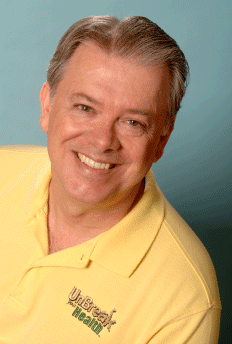
Join me for an interesting 20-minute conversation with Trent McEntire, President of the Board of Directors for the Pilates Method Alliance. You'll learn who Joseph Pilates was and how his process of physical education is both exercise and therapy.
Go to Pilates.
Showing posts with label wellness. Show all posts
Showing posts with label wellness. Show all posts
Saturday, June 26, 2010

Thursday, December 17, 2009
Positive Attitude is Best Medicine
Optimism is good for you according to a study of 100,000 women published in Circulation magazine. They have a 16% lower risk of heart attacks. This research confirms similar findings in a 2004 Danish study.
Pessimists had a 19% higher risk for early death according to a 2000 Mayo Clinic study.
Optimists have better immune system functioning, quicker recovery from heart surgery and greater ability to handle life-threatening illnesses like cancer. The good news is everyone can learn to be more optimistic, even pessimists. Wouldn't you prefer to wake up on the right side of the bed every morning?
Optimism is its own reward.
Pessimists had a 19% higher risk for early death according to a 2000 Mayo Clinic study.
Optimists have better immune system functioning, quicker recovery from heart surgery and greater ability to handle life-threatening illnesses like cancer. The good news is everyone can learn to be more optimistic, even pessimists. Wouldn't you prefer to wake up on the right side of the bed every morning?
Optimism is its own reward.
Monday, October 5, 2009
Autism Increases
Two new government studies indicate about 1 in 100 children have autism disorders. The figure is much higher than a previous U.S. estimate of 1 in 150. While federal health officials claim that greater awareness, broader definitions and spotting autism in younger children may explain some of the increase it's the same explanation given every time the figures escalate. The latest estimate translates to about 673,000 American children having autism compared to earlier estimates which put the number at about 560,000.
"The concern here is that buried in these numbers is a true increase," said Dr. Thomas Insel, director of the National Institute of Mental Health. "We're going to have to think very hard about what we're going to do for the 1 in 100."
The bigger question, the one nobody seems to be asking, is what are we doing to our health in this country to produce this problem?
"The concern here is that buried in these numbers is a true increase," said Dr. Thomas Insel, director of the National Institute of Mental Health. "We're going to have to think very hard about what we're going to do for the 1 in 100."
The bigger question, the one nobody seems to be asking, is what are we doing to our health in this country to produce this problem?
Friday, August 21, 2009
Divorce Health Scars
Half of the marriages in America end in divorce and that's bad news for the health of those involved. A Chicago study found that divorced people have 20% more chronic illnesses such as cancer than those who never marry. The figure drops to 12% for those who are able to remarry. The rate for those couples who stay married is the same for those who never marry.
The study, published in the Journal of Health and Social Behavior, involved 8,652 people aged 51 to 61.
It should be noted that people who remarry do tend to be happier they gain little in terms of chronic health conditions.
There are several lessons in this study, the most obvious is that divorce leaves many scars. It also demonstrates again that our emotional health impacts our physical health. One of the advantages of complementary and alternative medicine is that looks at the whole person because these therapies appreciate that the source of health problems can be in your mind or spirit. What's sad is that Western medicine is still doing studies to discover this fundamental human truth.
The study, published in the Journal of Health and Social Behavior, involved 8,652 people aged 51 to 61.
It should be noted that people who remarry do tend to be happier they gain little in terms of chronic health conditions.
There are several lessons in this study, the most obvious is that divorce leaves many scars. It also demonstrates again that our emotional health impacts our physical health. One of the advantages of complementary and alternative medicine is that looks at the whole person because these therapies appreciate that the source of health problems can be in your mind or spirit. What's sad is that Western medicine is still doing studies to discover this fundamental human truth.
Friday, May 8, 2009
Recession Stress Adds Pounds
A survey by CareerBuilder.com shows that 40% of us have packed on the pounds as a result of stress recently. The problem? Snacking. Two-thirds report snacking once a day while 24% snacked twice each day. That will pack it on!
Stress is connected to many health problems including heart disease and several digestive disorders. Now, more than ever, it's worth it to take the time for yourself to deal with the stress in your life. Tai Chi, meditation, yoga, massage are just a few ways to help handle stress. Even taking the time to stop and smell the roses as you take a daily walk would help ... it's part of living in the moment or what's called mindfulness.
It also helps to mind what your eating!
Stress is connected to many health problems including heart disease and several digestive disorders. Now, more than ever, it's worth it to take the time for yourself to deal with the stress in your life. Tai Chi, meditation, yoga, massage are just a few ways to help handle stress. Even taking the time to stop and smell the roses as you take a daily walk would help ... it's part of living in the moment or what's called mindfulness.
It also helps to mind what your eating!
Sunday, December 14, 2008
Happiness Is Contagious
Our emotions are infectious but positive emotions are much stronger than negative ones, that's the conclusion of a recent study that followed 4,700 people for 20 years published recently in BMJ, a British medical journal. One person's happiness can affect another's for up to a year too so it's not simply a fleeting ripple through social circles.
It's interesting that proximity is such a major factor in our responses. For example we need a friend who lives close to us for greater affect. The greater the distance the lower the impact. It's also fascinating that we apparently have social filters because a neighbor we see rarely can have more impact on our emotions that co-workers that we see every day.
So next time you're sad, it may just be the people you're hanging around with! Find happy people and you'll be happy too!
It's interesting that proximity is such a major factor in our responses. For example we need a friend who lives close to us for greater affect. The greater the distance the lower the impact. It's also fascinating that we apparently have social filters because a neighbor we see rarely can have more impact on our emotions that co-workers that we see every day.
So next time you're sad, it may just be the people you're hanging around with! Find happy people and you'll be happy too!
Thursday, July 3, 2008
Don't Worry, Be Happy
According to a recent report Denmark, with its democracy, social equality and peaceful atmosphere, is the happiest country in the world. Zimbabwe, torn by political and social strife, is the least happy. To illustrate that money can't buy happiness the U.S., the world's richest nation, ranks 16th.
Overall, the world is getting happier. It found increased happiness in 45 of 52 coutnries studied from 1981 to 2007.
So don't worry about rising oil prices, food prices and other problems. Be happy!
Seriously, it's not what happens to us in life, it's how we react to it that matters. Take time for yourself each day. Live in the moment. Meditate and find the peace within. Not only will you be happier but your health will benefit.
Overall, the world is getting happier. It found increased happiness in 45 of 52 coutnries studied from 1981 to 2007.
So don't worry about rising oil prices, food prices and other problems. Be happy!
Seriously, it's not what happens to us in life, it's how we react to it that matters. Take time for yourself each day. Live in the moment. Meditate and find the peace within. Not only will you be happier but your health will benefit.
Friday, May 16, 2008
What Does It Take?
I often wonder what it takes to get people to take responsibility for their own health. I view this as the first step before they'll even consider the world of hope called complementary and alternative medicine. I have to admit that in my case, it took running out of medical options, although I hope others are much smarter.
A recent report on cancer survivors following minimal recommendations has me shaking my head and wondering what it takes to get people involved in their own health. You'd think that surviving cancer would do it, wouldn't you? But you'd be wrong.
The American Cancer Society issued three fundamental recommendations in 2006 on healthy lifestyle behaviors: get at least 150 minutes of moderate-to-strenuous exercise, or an hour of strenuous physical activity every week; eat at least five servings of fruits and vegetables daily; and quit smoking. These are recommendations that every type of complementary and alternative therapy can agree on with mainstream medicine so that should give you an idea of how basic these suggestions are for maintaining good health.
Today we know that only 5% were meeting all three requirements. Pretty sad, isn't it? At the same time just over 12% were meeting none and fewer than 10% of cancer survivors of any of the six cancer types in the study were meeting two or more recommendations.
Once again I pose the question: What in the world does it take???
A recent report on cancer survivors following minimal recommendations has me shaking my head and wondering what it takes to get people involved in their own health. You'd think that surviving cancer would do it, wouldn't you? But you'd be wrong.
The American Cancer Society issued three fundamental recommendations in 2006 on healthy lifestyle behaviors: get at least 150 minutes of moderate-to-strenuous exercise, or an hour of strenuous physical activity every week; eat at least five servings of fruits and vegetables daily; and quit smoking. These are recommendations that every type of complementary and alternative therapy can agree on with mainstream medicine so that should give you an idea of how basic these suggestions are for maintaining good health.
Today we know that only 5% were meeting all three requirements. Pretty sad, isn't it? At the same time just over 12% were meeting none and fewer than 10% of cancer survivors of any of the six cancer types in the study were meeting two or more recommendations.
Once again I pose the question: What in the world does it take???
Subscribe to:
Posts (Atom)


 Posts
Posts